
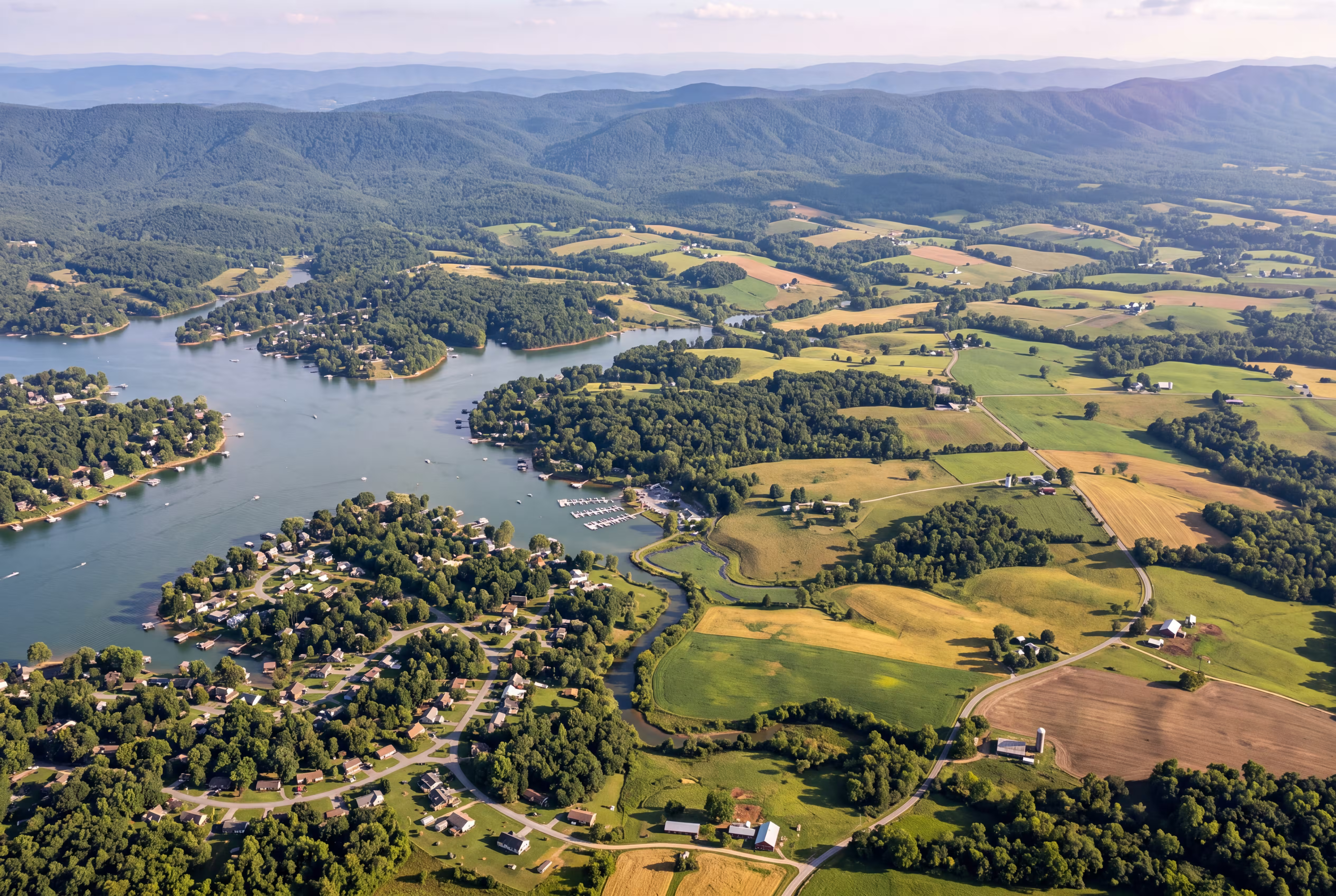
A lake house or a place with real acreage is the dream for a lot of Central Virginia buyers – and it’s a different game than buying a home in a subdivision. In practice, that means taking on a handful of things a subdivision never asks about: a private well and septic system, recorded access easements, shoreline permits, and financing that values land differently. Out here, the land and the water come with their own rules. You might be your own water and sewer company. The lines on the listing may not match the lines on the ground. The dock you pictured may need a permit from a power company. And the financing works differently than it does on a typical house in town.
None of that should scare you off – it should just mean you go in with your eyes open. This is a plain-English guide to what actually trips people up when buying a lakefront or rural home across Lake Anna, Lake Monticello, and our rural counties, so the land becomes the dream and not the surprise. One note up front: this covers the big-picture realities, not legal, tax, or lending advice – the specifics belong with a surveyor, an inspector, an attorney, and your lender.
On most rural and many lake properties, there’s no city water main or public sewer at the street. You’re on a private well and a septic system – which means two of your most important inspections have nothing to do with the house itself.
A well is only as good as what it produces and what’s in it, and lenders care about both. On a government-backed loan (FHA, VA, or USDA), the well generally has to deliver a sustained flow – lenders typically look for somewhere around 3 to 5 gallons per minute over a timed test – and the water has to pass a lab panel for bacteria (total coliform), lead, nitrates, and nitrites. A well that tests low on flow isn’t necessarily a dealbreaker; it can often be engineered to pass with an atmospheric storage tank and a booster pump. But that’s a cost and a conversation to have before closing, not after. There are also setback rules – a well generally sits at least 50 feet from a septic tank and 100 feet from the drainfield – that matter if anyone’s planning to add on or re-drill.
Virginia changed the rules here recently, and there’s a myth worth killing: House Bill 2671 (effective July 2025) did not make a septic inspection mandatory on every sale. What it did do is raise the bar on how an inspection is done when one happens – it has to be performed by a state-licensed Onsite Sewage System Professional under a written contract, not a general home inspector. Get that inspection anyway; it’s one of the most important things you’ll do on a rural property.
The single biggest septic trap is capacity. A system is permitted for a specific number of bedrooms, and that number has to match the house. If a home is marketed as a four-bedroom but the Virginia Department of Health permit says three, that’s not a technicality – it can mean a failed appraisal, a misrepresentation problem, and a real bill to fix. Always pull the VDH operation permit and confirm the permitted bedroom count matches what you’re buying. And know the ranges: repairing or replacing a conventional system typically runs $5,000 to $15,000, while an advanced (“alternative”) system that needs an annual maintenance contract can run $15,000 to $35,000 or more. Lining up a licensed septic inspector, a well specialist, and a surveyor is exactly what our Concierge Circle is for.
With land, you’re not just buying a house – you’re buying a bundle of rights, and a few of them are easy to assume and expensive to get wrong.
Start with access. A gravel driveway or a dirt track across a neighbor’s field does not automatically give you the legal right to use it. In Virginia, legal access has to run through a recorded easement (or public road frontage) in an unbroken chain all the way to a state-maintained (VDOT) road. If there’s a gap, you can own a beautiful parcel you can’t legally reach. The good news is that lenders have loosened up: the VA, for example, no longer demands a signed private-road maintenance agreement from every neighbor, as long as there’s a recorded, permanent easement. But you still want a title company and, ideally, a survey to confirm the access – and the actual boundary lines, which fences rarely match – before you commit.
Then there are conservation easements, common on larger and rural-luxury tracts here. A conservation easement is a permanent deed restriction that limits how land can be divided or developed, in exchange for preserving it. It isn’t automatically bad: Virginia’s Land Preservation Tax Credit can give a landowner a state income-tax credit worth 40% of the donated value, usable up to $20,000 a year, carried forward up to 10 years, and even sold to other taxpayers. But it also binds what you and every future owner can build, so if a property has one – or you’re considering placing one – read it closely and bring in a tax advisor and an attorney.
“Waterfront” means more than a view. It means a second layer of rules about what you can build, what you can touch, and what you’ll pay to insure – and those rules are completely different at our two main lakes.
Lake Anna was created in 1972 as a cooling reservoir for the North Anna Power Station, and that origin still shapes everything. It’s split into a larger public side (roughly 9,600 acres) and a smaller, warmer private side (about 3,400 acres). Dominion Energy holds a shoreline easement around the lake and controls the water and the bank from the 250-foot normal-pool line up – which means owning waterfront land does not automatically give you the right to build over the water. Every dock, boathouse, and bit of shoreline work needs a license from Dominion, on top of county and sometimes state and federal sign-off.
The rules have real teeth for buyers, and they come straight from Dominion Energy: a parcel needs at least 54 linear feet of shoreline to qualify for a dock at all, structures top out around 3,000 square feet on the widest lots, and height is capped (roughly 20 feet for a flat roof, 28 for a pitched one, above the pool). The most important move when buying a home with an existing dock: make sure the Dominion shoreline permit is formally assigned to you at closing, or you can inherit someone else’s unauthorized-structure problem. Which county you’re in – Louisa, Spotsylvania, or Orange – also changes the rules, especially around short-term rentals.
Lake Monticello is the opposite kind of place: a gated, amenity-rich private community in Fluvanna County, built around a 352-acre lake with a golf course, five beaches, and a marina, and run by the Lake Monticello Owners’ Association (LMOA). Two things matter most for buyers. First, most homes here are on public water and sewer – not private well and septic – which quietly removes the single biggest rural headache. Second, this is a covenant-governed community: there are HOA dues (recently around $1,238 a year), an architectural committee that approves docks and exterior changes, and real rules on the water (no jet skis, a 35-mph limit). Always get the LMOA disclosure packet and read the reserve fund and any upcoming assessments, because unpermitted changes a seller made can become your problem at closing.
For anything near water or low-lying ground, check the FEMA flood map for the specific parcel before you fall in love. If a home sits in a high-risk flood zone, your lender will require flood insurance, which adds to your monthly cost and can vary a lot from property to property. Many lake and rural homes aren’t in high-risk zones, but some low spots are – it’s a quick thing to confirm early and an expensive thing to discover late.
The money works differently out here, in ways that catch even experienced buyers off guard. The biggest one is the appraisal. Lenders value the house plus a typical home site – usually the dwelling and roughly 1 to 5 acres – at full comparable value, then treat the rest as “excess land” that contributes far less per acre. The first few acres might appraise at full value; acreage beyond the home site often adds only a few thousand dollars an acre unless there are real comparable sales to support more. Big outbuildings – barns, riding arenas, workshops – usually don’t get dollar-for-dollar credit either. The practical result: on a large parcel, the appraisal can land under the purchase price simply because the land and the barn “don’t count” the way you’d expect, so plan for that gap.
Your loan type matters just as much:
Same category, three very different playbooks – which is exactly why local knowledge earns its keep. Here’s the quick side-by-side:
At Lake Anna, you’re buying into a Dominion-governed, three-county lake with a clear split between the public side (marinas, restaurants, more boat traffic, a strong second-home and rental market) and the quieter private side – where shoreline permits and county rules are the whole game.
At Lake Monticello, you’re buying into a gated, amenity-driven community of mostly full-time residents, where public utilities and HOA governance do the heavy lifting – a very different due-diligence list than open water.
And in the rural counties, the land itself is the asset. Louisa and Buckingham offer larger, more affordable acreage (Buckingham especially, with big timber and farm tracts); Nelson adds mountain-slope building rules and by-right agritourism, wineries, and breweries in its agricultural districts; and Greene, along the Shenandoah Park border, is widely USDA-eligible. Wells, septic, easements, and zoning are the constants. You can explore all of these on our Our Neighborhoods page.
Yes. Beyond a standard home inspection, plan on a licensed septic inspection (by a state-licensed Onsite Sewage System Professional under Virginia’s HB 2671 rules), a well flow-and-water-quality test, and ideally a boundary survey. On the water, add a review of the shoreline permit or HOA approvals.
Only with Dominion Energy’s permission, and only if your lot qualifies. A parcel needs at least 54 linear feet of shoreline to have a dock, structures are size- and height-capped, and any dock work needs a Dominion license plus county review. Buying a home with an existing dock? Make sure the permit is assigned to you at closing.
Mostly no – most Lake Monticello homes are on public water and sewer, which removes the private well and septic risks you’d face on surrounding rural land. It is, however, a gated HOA community with dues, architectural rules, and lake-use restrictions, so the due diligence shifts to the LMOA disclosure packet.
Often, yes. USDA Rural Development offers 100% financing on primary residences in designated rural areas across much of Central Virginia, provided the property’s well and septic meet health standards. Eligibility is tied to the specific location, so it’s worth checking an address.
An easement is a recorded right to use land for a specific purpose – a shared driveway, a utility line, or a conservation restriction. It matters because it can guarantee (or jeopardize) your legal access to a property, limit what you can build, or affect value. Always confirm recorded access to a public road and review any easements before buying.
If the property sits in a FEMA-designated high-risk flood zone, your lender will require it. Many lake and rural homes aren’t in high-risk zones, but some low-lying parcels are – so check the FEMA flood map for the specific property early.
A lake house or a piece of land should be the easiest thing in the world to fall in love with – and it can be, as long as the wells, septic, easements, shorelines, and financing are handled before you’re emotionally (and financially) committed. That’s not a reason to hesitate; it’s a reason to have people who’ve done it dozens of times reading the fine print alongside you.
This is exactly the kind of property where local, niche experience saves a deal. Get niche-property guidance, and we’ll walk the water, the land, and the paperwork with you – so what you’re buying is the dream, not the surprise. Central Virginia’s real estate team is ready when you are.

Yes. Beyond a standard home inspection, plan on a licensed septic inspection (by a state-licensed Onsite Sewage System Professional under Virginia’s HB 2671 rules), a well flow-and-water-quality test, and ideally a boundary survey. On the water, add a review of the shoreline permit or HOA approvals.
Only with Dominion Energy’s permission, and only if your lot qualifies. A parcel needs at least 54 linear feet of shoreline to have a dock, structures are size- and height-capped, and any dock work needs a Dominion license plus county review. Buying a home with an existing dock? Make sure the permit is assigned to you at closing.
Mostly no – most Lake Monticello homes are on public water and sewer, which removes the private well and septic risks you’d face on surrounding rural land. It is, however, a gated HOA community with dues, architectural rules, and lake-use restrictions, so the due diligence shifts to the LMOA disclosure packet.
Often, yes. USDA Rural Development offers 100% financing on primary residences in designated rural areas across much of Central Virginia, provided the property’s well and septic meet health standards. Eligibility is tied to the specific location, so it’s worth checking an address.
An easement is a recorded right to use land for a specific purpose – a shared driveway, a utility line, or a conservation restriction. It matters because it can guarantee (or jeopardize) your legal access to a property, limit what you can build, or affect value. Always confirm recorded access to a public road and review any easements before buying.
If the property sits in a FEMA-designated high-risk flood zone, your lender will require it. Many lake and rural homes aren’t in high-risk zones, but some low-lying parcels are – so check the FEMA flood map for the specific property early.
Increasingly, yes – but confirm it at the exact address before you commit. Fiber is reaching much of rural Central Virginia: Firefly Fiber Broadband, the utility-cooperative project built with Central Virginia Electric Cooperative, has been wiring rural Louisa, Fluvanna, Nelson, and neighboring counties, including the Lake Anna area. Where fiber hasn’t landed yet, options include fixed wireless, cellular home internet, and satellite such as Starlink. Availability can change street by street out here, so check what’s actually serviceable at the specific parcel – especially if you plan to work from home.



